How to Use Finishing Salt (Guide to Types and Uses)
Finishing salt is used at the end of cooking to control how a dish tastes just before serving. A small pinch added at the end of cooking can sharpen sweetness, soften bitterness, deepen savoury flavours, and change how aromas rise from warm food. The same ingredient behaves differently depending on its crystal structure, mineral balance, and the moment it is added during cooking.
At Maison Kojira we study how salt structure shapes flavour in cooking. This guide explains what finishing salt is, how to use finishing salt correctly, when to apply it, the different types of finishing salt, and how it behaves across different foods. If you want to explore the deeper science behind how salt changes the flavour of food, you can continue to our guide How Salt Affects Flavour.
What Is Finishing Salt?
Finishing salt is used at the end of cooking to control how a dish tastes at the moment it is eaten.
As the salt meets heat and surface moisture, some crystals dissolve while others remain intact. This creates a layered effect across each bite: part of the seasoning spreads, while part stays distinct.
Because the crystals remain partly on the surface, finishing salt shapes how flavour is experienced at the moment of eating. A small pinch can bring sweetness forward, reduce bitterness, deepen savoury notes, and lift aroma as the food reaches the table.
It is used at the end of cooking because it does not distribute evenly. Instead, it defines the final balance of the dish through controlled, surface-level seasoning. Because finishing salt acts on the surface, how it is applied matters.
How Different Foods Absorb Salt
Salt does not behave the same way on every ingredient.
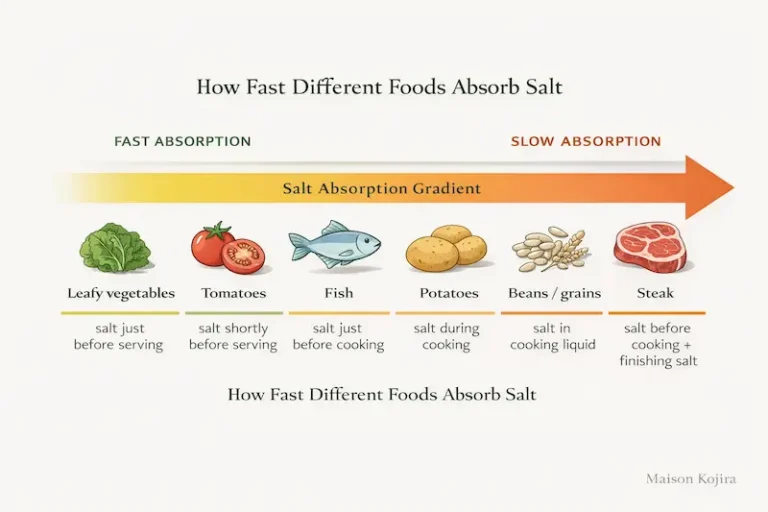
Different foods absorb salt at different speeds depending on their structure, moisture content, and surface texture. Some ingredients allow salt to penetrate slowly, while others absorb it almost immediately.
This is why chefs adjust when and how salt is applied depending on the ingredient.
For example, a steak can be salted well before cooking because salt moves gradually into the meat. Fresh vegetables absorb salt quickly and are therefor often seasoned closer to serving. Foods like beans or grains often receive most of their seasoning at the surface.
The differences become clearer when you look at how salt moves through different foods.
How To Use Finishing Salt
Finishing salt is applied at the end of cooking, just before serving. Do not mix it into the dish.
- Use a small pinch. Start lightly and adjust.
- Apply from slightly above the food so the crystals distribute evenly across the surface.
- Adjust based on the surface. Warm, moist foods allow partial dissolution. Dry or crisp surfaces keep crystals more intact.
- Taste and adjust immediately before serving. Apply in response to the dish, not by fixed measurement.
Use less on delicate foods where flavour can be overwhelmed, and slightly more on neutral or dense foods where the salt defines the final taste. Fatty foods often require slightly more finishing salt, as fat softens the perception of salinity and reduces its immediate impact.
For a deeper look at timing, distribution, and control, see how chefs use finishing salt in professional kitchens.
What Is Finishing Salt Used For?
Finishing salt is used to adjust flavour at the final moment before serving. It is applied to the surface of food to add contrast, texture, and a more precise balance of taste.
Because the crystals remain partly intact, finishing salt does not season evenly. Instead, it creates variation across each bite — some softer, some sharper — which makes flavour feel more defined.
It is most often used on foods where seasoning remains on the surface rather than being absorbed during cooking.
Meat and Seafood
Salt settles into juices released by warm proteins and highlights savoury flavour.
→ How to Use Finishing Salt on Meat
→ How to Use Finishing Salt on Seafood
Eggs
Salt catches on the warm yolk and soft whites, making eggs taste richer, cleaner, and more complete.
Dairy
→ How to Salt Yoghurt
→ How to Salt Burrata, Ricotta & Feta
Vegetables and Fresh Produce
Vegetables respond quickly to surface seasoning because of their moisture content and delicate structure.
→ How to Use Finishing Salt on Vegetables
→ How to Salt Tomatoes
→ How to Salt Asparagus
→ Do You Need to Salt Aubergine or Eggplant?
→ How to Salt Zucchini or Courgette
→ When to Salt Mushrooms
→ How to Salt Beetroot or Beets
Bread, Pasta and Grains
Starchy foods absorb salt differently. Much of the seasoning remains on the surface, sharpening flavour in each bite.
→ Best Salts for Olive Oil Bread Dip
→ How to Salt Pasta
→ How to Salt Rice
→ How to Salt Risotto
→ How to Salt Grain Salads
Potatoes
→ When to Salt Potatoes
→ When to Salt Fries
→ When to Salt Roast Potatoes
→ How to Salt Boiled Potatoes
→ How to Salt Mashed Potatoes
Simple Foods
Minimal dishes and sauces often rely on finishing salt to clarify flavour at the last moment.
→ How to Use Finishing Salt on Simple Foods
Fruits and Desserts
Small amounts of salt intensify sweetness and increase aromatic contrast in fruit and chocolate-based desserts.
→ Salt on Fruit
→ Salt on Desserts
Different Types of Finishing Salt
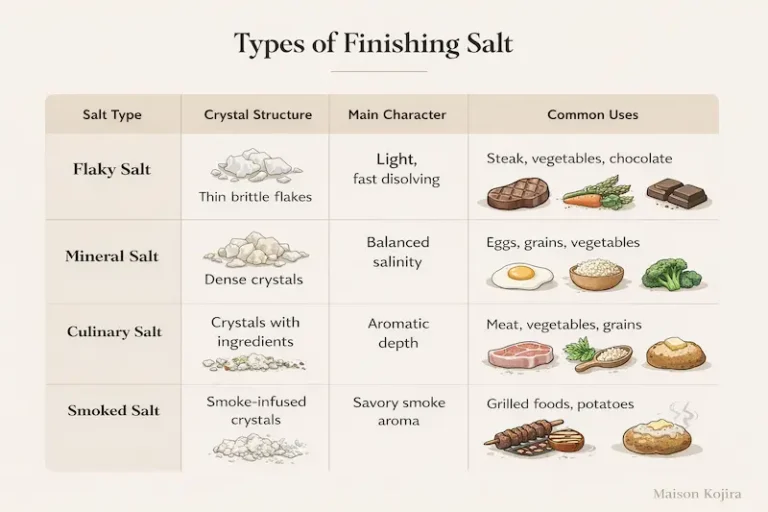
In practice, most finishing salts used in cooking fall into four broad categories, based on crystal structure, mineral composition, and flavour, which is shown below.
Flaky Salts
Flaky salts form light, brittle crystals that break easily between the fingers.
Because the crystals contain small pockets of air, they dissolve quickly when they touch warm food. This creates a gentle seasoning effect and a delicate texture contrast.
Chefs often use flaky salts to finish dishes such as grilled meat, roasted vegetables, salads, and chocolate desserts.
Mineral Salts
Mineral salts are harvested from underground deposits formed by ancient evaporated seas.
These salts often contain trace minerals such as magnesium, calcium, and potassium. While the flavour difference is subtle, mineral salts are often described as having a rounder and more balanced salinity than highly refined salts.
Many chefs prefer mineral finishing salts because they deliver clean seasoning while preserving the natural mineral structure of the salt.
Some artisan mineral salts are harvested from inland mineral basins formed by ancient seabeds, for example our Kojira Artisan Mineral Salt.
Culinary Salts
Many modern culinary salts integrate transformed ingredients directly into salt crystals. Rather than simply mixing dried ingredients with salt, these salts often begin with ingredients that have been fermented, aged, cured, or slowly dried before being combined with the salt.
Examples include:
- umami salts, such as fermented mushroom salt or black garlic salt
- citrus salts, such as preserved lemon salt
- saffron salts, such as Persian saffron salt
- herb salts, such as rosemary or thyme salts
These preparation methods deepen flavour and allow the salt to contribute more than salinity alone. Mushrooms can develop concentrated savoury compounds, garlic can transform into sweet, dark black garlic during aging, and citrus can soften through salt preservation before being dried and blended with the salt.
Umami salts rely on ingredients naturally rich in glutamates and related compounds that deepen savoury flavour in food. If you want to understand how these compounds interact with salt in cooking, see our guide to umami salt.
These salts are commonly used on meat, eggs, vegetables, and grains where they contribute both seasoning and aromatic depth in a single pinch.
Smoked Salts
Smoked salts are created by exposing salt crystals to wood smoke. Different woods produce different aromas. Common smoking woods include:
- oak: produces a balanced, warm smoke with subtle toasted and woody notes
- hickory: stronger and deeper smoke, often associated with bacon-like savoury aromas
- applewood: milder smoke with a slightly sweet, fruity character.
- alder: very light, clean smoke often used for delicate foods like fish.
Smoked salts are often used on grilled meat, roasted vegetables, eggs, and potatoes where the smoke aroma complements caramelised flavours.
Other Traditional Specialty Salts
Some salts are also valued for distinctive production methods or unusual mineral compositions. Examples include kala namak (Indian black salt), Korean bamboo salt roasted inside bamboo tubes, and various roasted or volcanic salts used in regional cuisines.
These salts are typically associated with specific culinary traditions rather than everyday finishing use, but they illustrate how production methods and mineral environments can influence the character of salt.
Enjoy guides like this?
Receive flavour insights, rare kitchen notes, and early access to limited Maison Kojira releases.
How Finishing Salt Changes Flavour
Salt applied at the final stage of cooking changes flavour in several ways that go beyond simple salinity. Because the crystals remain partly on the surface of food, salt interacts with taste receptors, aroma compounds, and moisture in the final moments before eating.
Food scientists often describe salt’s influence through several core mechanisms:
- salt sharpens flavour perception, by reducing bitterness and enhancing sweetness and savoury flavours
- salt releases aroma molecules
- salt changes how moisture moves through food
- salt affects the texture of food
- salt affects mouthfeel
- adding salt to food enhances browning
These 6 mechanisms explain why a small pinch of salt can noticeably change how a dish tastes. If you want to explore these mechanisms in detail see our guide How Salt Changes Flavour, which describes the flavour architecture of salt in more detail.
Some culinary salts deepen savoury flavour by integrating ingredients rich in glutamates, such as mushrooms or aged garlic. You can see how these principles work in our guide to umami salt.
What Makes a Great Finishing Salt
Not all salts perform equally well as finishing salts. Different salts taste different. Chefs judge finishing salts based on a few practical characteristics:
- crystal size, which determines how quickly the salt dissolves
- mineral composition, which can subtly influence the character of salinity
- ingredient integration, where herbs, citrus, garlic, mushrooms, or spices contribute additional flavour alongside the salt
Professional kitchens tend to favour salts that provide clear seasoning, good tactile control, and a balanced salinity that complements food rather than dominating it.
Why Crystal Size Matters
Crystal size strongly influences how salt behaves on food. Larger crystals dissolve more slowly than fine salt, creating small bursts of salinity as they dissolve across several bites instead of disappearing immediately into the dish. This is why different salts not taste the same.
They also give chefs better visual and tactile control. A pinch of coarse salt spreads more evenly and predictably than a dense pinch of fine salt, which is why most kitchens reserve finely ground salt for cooking rather than finishing.
Why Fine Salt Is Easy to Oversalt
Fine salt dissolves very quickly when it touches food. Because the crystals are small and densely packed, a single pinch contains more sodium than a pinch of coarse salt.
This makes fine salt useful during cooking, when seasoning needs to distribute evenly throughout a dish. As a finishing salt, however, it can be harder to control.
Coarse crystals dissolve more gradually and provide clearer visual cues when seasoning. This allows flavour to build more gently across the surface of food and reduces the risk of oversalting.
For this reason, many kitchens use fine salt for cooking and larger crystals when finishing dishes.
Why Mineral Content Affects the Taste of Finishing Salt
Salt is primarily sodium chloride, but natural salts often contain small amounts of other minerals such as magnesium, calcium, and potassium.
These minerals rarely dominate flavour, yet they can influence how salinity is perceived. Many cooks describe mineral salts as having a rounder or softer taste compared with highly refined salts that contain almost pure sodium chloride.
Why Ingredients Are Integrated Into Culinary Finishing Salts
Some finishing salts incorporate additional ingredients that contribute flavour in addition to salinity.
In simple versions, herbs or citrus zest are blended directly with salt crystals. More complex culinary salts transform the ingredients first. Mushrooms may be fermented, garlic aged into black garlic, or citrus preserved before being dried and combined with the salt.
These processes deepen flavour and allow the salt to deliver aroma, savoury depth, or brightness alongside seasoning.
Frequently Asked Questions About Finishing Salt
What is finishing salt?
Finishing salt is salt added at the final stage of cooking so the crystals remain partly intact on the surface of the food. The crystals remain visible on the surface and release flavour as they dissolve during eating.
Why do chefs use finishing salt instead of regular salt?
Chefs use finishing salt because larger crystals dissolve slowly and remain partly on the surface of food. This allows cooks to adjust flavour precisely at the end of cooking and creates small bursts of seasoning across several bites.
Some finishing salts also include ingredients that contribute additional flavour. Culinary salts made with ingredients such as fermented mushrooms, aged garlic, citrus peel, or saffron can add aromatic depth alongside salinity. Instead of adding several seasonings separately, chefs can introduce both seasoning and flavour complexity with a single pinch.
At Maison Kojira, many of our culinary salts follow this principle by integrating transformed ingredients into mineral salt to create finishing salts that contribute both seasoning and layered flavour.
What foods benefit most from finishing salt?
Finishing salt is commonly used on grilled meat, roasted vegetables, eggs, fish, potatoes, salads, and chocolate desserts. These foods have enough surface moisture for salt crystals to dissolve gradually and enhance flavour.
Can you cook with finishing salt?
Yes. Finishing salt can be used both during cooking and at the end of a dish. When added during cooking, the crystals dissolve into the food and provide balanced seasoning throughout the dish.
When used as a finishing salt, the crystals remain partly on the surface of warm food and dissolve gradually as they meet moisture and heat. This creates small bursts of flavour and light texture just before serving.
Many culinary salts, especially those that integrate ingredients such as mushrooms, citrus, or saffron, work well in both roles, contributing flavour during cooking and adding aromatic depth when used as a finishing touch.